Introduction
You turn on your kitchen tap, fill a glass with water and hold it against the light. It looks perfectly clear. There is no unusual smell, no visible dirt and no strange taste. So, naturally, you assume the water is safe to drink. But is that enough to know? Clear water can contain bacteria or other microorganisms that cannot be detected simply by looking at the water. Some harmful germs do not noticeably change water's colour, taste or smell. At the same time, clear water is not automatically contaminated just because microorganisms are possible. Municipal water supplies are generally treated to make water safe for drinking. However, the quality of water reaching your glass can also depend on the distribution system, the condition of household plumbing, overhead storage tanks and how drinking water is handled at home. For families, students and working professionals living in Coimbatore and other Indian cities, understanding this difference is an important part of making informed drinking-water decisions. Let's look at why invisible contamination is possible, how to link textcheck water quality and when a household water purifier may be appropriate.
1. Why does water look clean even when contamination is possible?
Water looks cloudy when it contains enough suspended particles to scatter light. But many microorganisms are too small to be seen individually with the naked eye. This means water can appear transparent while containing microorganisms that require laboratory methods to detect. Consider these three situations:
- Clear water: It may have low visible particle content, but its microbiological safety has not been established by appearance alone.
- Cloudy water: It may contain suspended particles and could require additional treatment, but cloudiness alone does not identify which contaminants are present.
- Clear, tested water: Suitable test results provide stronger evidence of safety for the parameters tested, although they cannot guarantee that water will remain safe indefinitely.
The important point is simple: clean-looking water and microbiologically safe water are not the same thing. The World Health Organization also explains that clear water does not necessarily mean water is free from disease-causing microorganisms
2. How can municipal water become contaminated after treatment?
Municipal water treatment systems are designed to reduce contaminants and protect public health. Properly operated and monitored piped supplies are an important source of drinking water. However, treatment at the source does not mean that contamination can never occur later. Here are some possible pathways. A. Damaged or leaking distribution pipes Water travels through a network of pipes before reaching individual homes. If a pipe is damaged, water pressure drops or repairs are carried out, contamination may sometimes enter the system under unfavourable conditions. This does not mean that every pipe leak makes drinking water unsafe. It means that distribution integrity is one factor in protecting water quality. B. Overhead and underground storage tanks In many Indian apartment buildings and independent houses, municipal water is stored in underground sumps and overhead tanks before use. If tanks are not properly covered, inspected and cleaned, dirt or other contaminants may enter. The condition of the tank, access openings, plumbing connections and surrounding environment all matter. Routine inspection and appropriate cleaning help maintain the storage system. However, a clean-looking tank does not by itself establish that the stored water is microbiologically safe. C. Household plumbing Water can also be affected by damaged plumbing, poorly maintained connections or cross-connections between drinking-water pipes and contaminated sources. If you notice a sudden change in water quality, a supply interruption or a local advisory, do not assume the water is safe merely because it becomes clear again. D. Handling and storage after collection Even water that was safe when collected can become contaminated through unclean containers, uncovered vessels, dirty dispensing taps or hands touching the water. For example, a family may collect treated municipal water in a clean-looking vessel but repeatedly dip an unwashed tumbler into it. This creates an avoidable contamination risk. The practical lesson: water safety depends on more than what happens at the municipal treatment plant. Distribution, storage and household handling also matter.
3. Which microorganisms may be present in drinking water?
Not all microorganisms are harmful. Many exist naturally in the environment, and their presence does not automatically mean the water will cause illness. The concern is the presence of disease-causing microorganisms, often called pathogens. Examples include:
- Certain bacteria: Some strains of Escherichia coli (E. coli) can indicate faecal contamination or cause illness.
- Certain viruses: Some waterborne viruses can cause gastrointestinal infections.
- Certain parasites: Organisms such as Giardia can spread through contaminated water.
The exact risk depends on the organism, its concentration, the amount of water consumed and the person's health. This is why drinking-water testing must use appropriate methods rather than relying on appearance alone. Testing for E. coli and other microbiological indicators can help identify evidence of contamination, while additional tests may be needed for particular risks
4. Why is this relevant to Indian households?
In India, households may receive municipal water directly, store it in tanks or use a combination of municipal, tanker and other supplies. Even within the same city, water sources and household plumbing arrangements can differ. For example, imagine two families living in different Coimbatore apartment buildings.
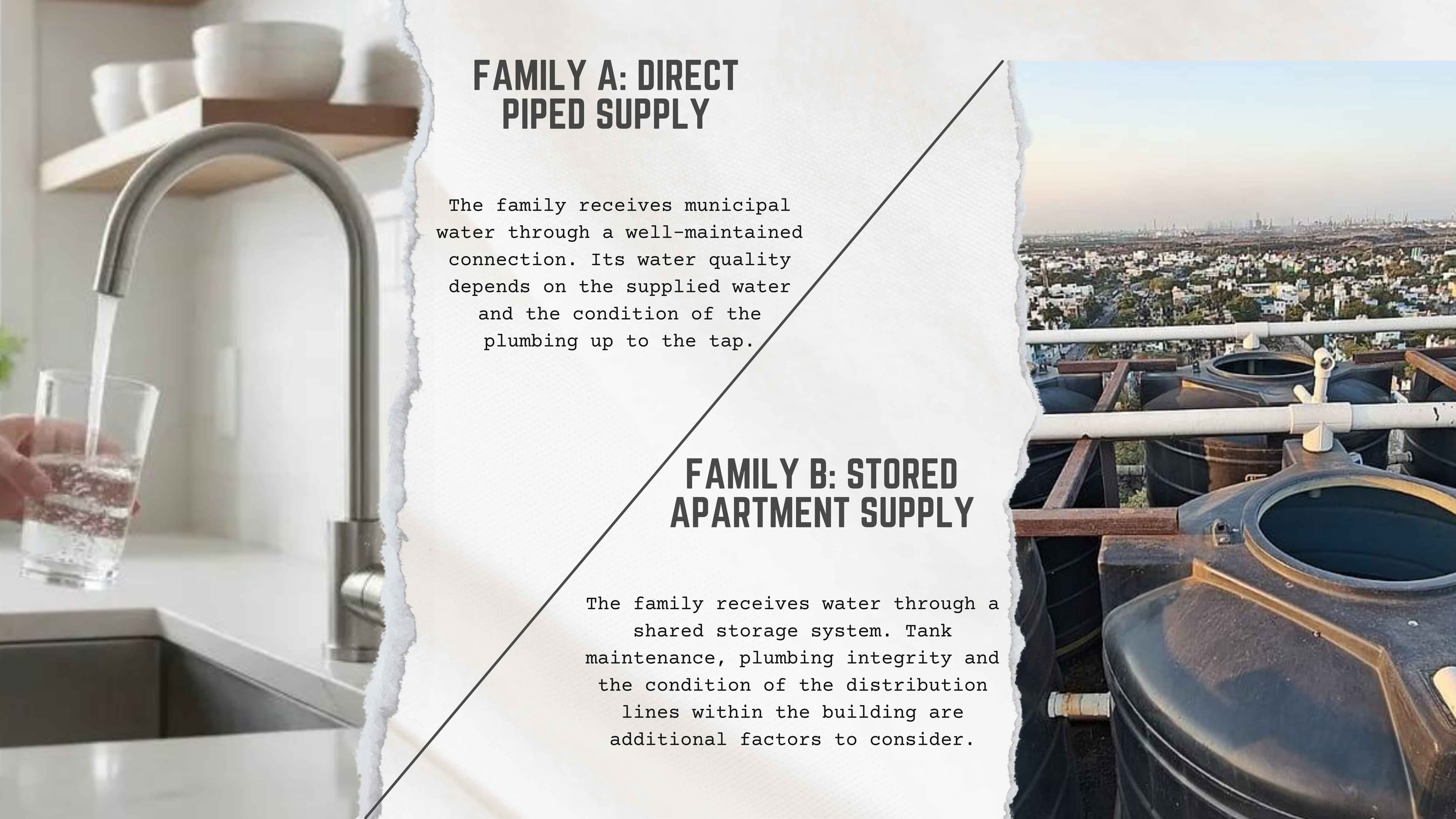
These examples illustrate possible differences; they do not establish that one household's water is safer than the other's. The same principle applies whether you live in a rented flat, an independent house or a larger residential community. In Coimbatore, it is sensible to understand your actual water source, ask about shared tank maintenance and investigate any water-quality concerns using appropriate tests. It would be misleading to assume that every neighbourhood or apartment has the same water-quality profile.
5. How can you check whether drinking water contains bacteria?
If you want to establish whether your water has microbiological contamination, the right approach is appropriate water-quality testing. Here is a practical starting point. 1. Identify your water source. Check whether your home receives municipal water directly or through a shared storage tank. If you also use tanker or borewell water, mention that when seeking testing advice. 2. Request suitable microbiological testing. Ask an appropriately qualified water-testing laboratory about tests for E. coli, total coliform bacteria and other parameters relevant to your supply. Total coliform results and E. coli results have different meanings and should be interpreted correctly. 3. Collect the sample properly. Follow the laboratory's sampling instructions. The sampling point, container, handling and time before analysis can affect results. If the concern involves contamination in the building's plumbing, testing only the municipal source may not resolve it. 4. Understand the report. Review the findings with the laboratory or an appropriate water-quality professional. Ask what the results mean, whether follow-up sampling is needed and which treatment method addresses any identified problem. 5. Retest when circumstances warrant it. Consider further testing after suspected contamination, plumbing repairs, a relevant water-supply advisory or changes in the water source. The appropriate frequency depends on the source and risk. India's Bureau of Indian Standards publishes the drinking-water specificationIS 10500,which provides a relevant reference for drinking-water quality and testing. A home test strip or handheld device may measure selected parameters, but it should not be treated as a substitute for suitable microbiological analysis.
6. Does a TDS meter detect bacteria in water?
No. A standard TDS meter does not detect bacteria. TDS stands for Total Dissolved Solids. It estimates the concentration of dissolved substances in water, commonly reported in parts per million (ppm). A TDS reading can help describe one aspect of water chemistry, but it does not establish whether the water contains harmful microorganisms.
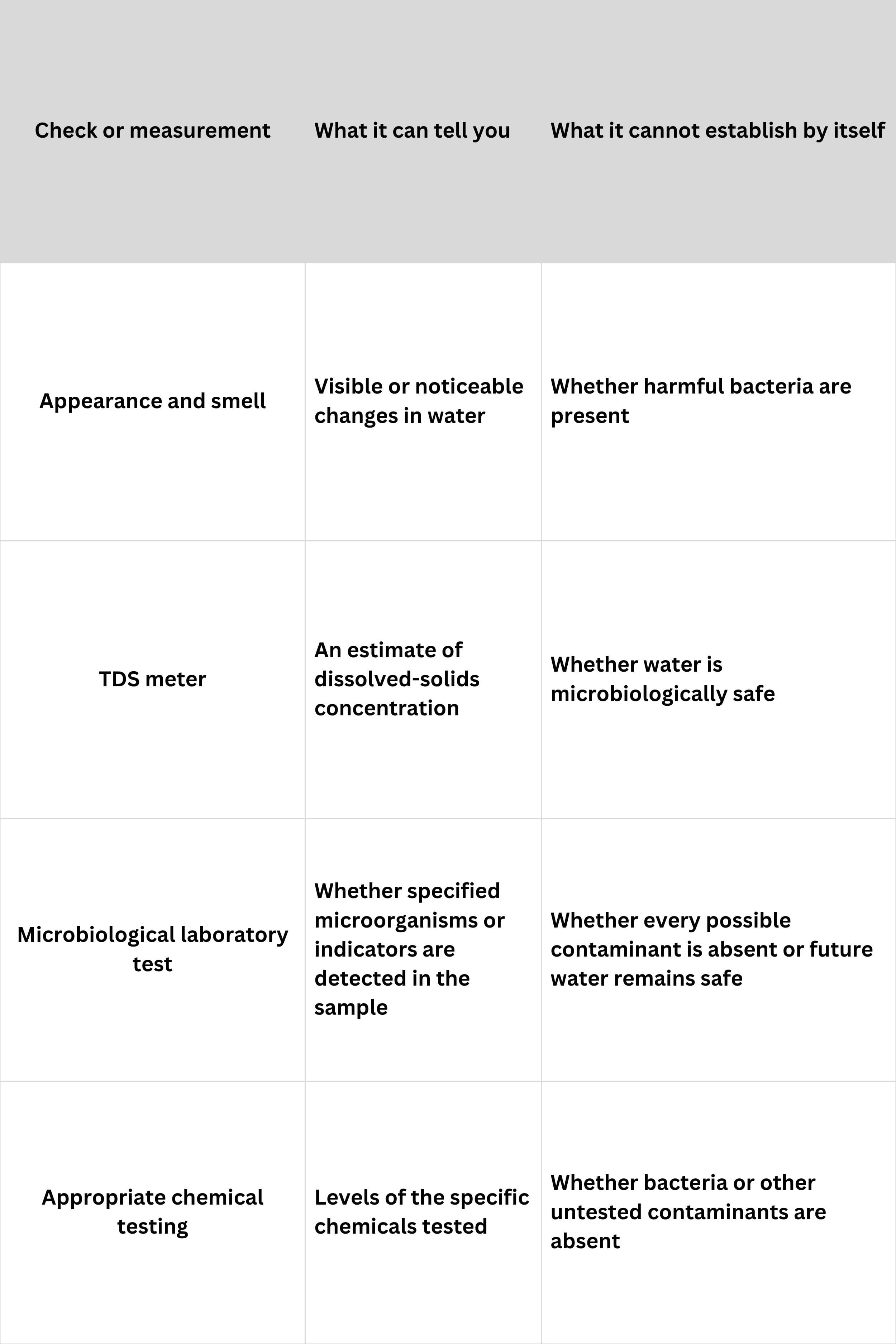
A low TDS reading is not proof of safe drinking water. A high TDS reading is not proof of bacterial contamination either. If you are choosing a water purifier, do not base the decision on a TDS reading alone. Consider the water source, relevant test results and the contaminants the treatment system is designed to address
7. Will a water purifier remove invisible bacteria?
It depends on the technology, the specific product and its operating conditions. A water purifier should be selected to address the risks actually identified or reasonably expected in the water supply. Different treatment technologies serve different purposes.
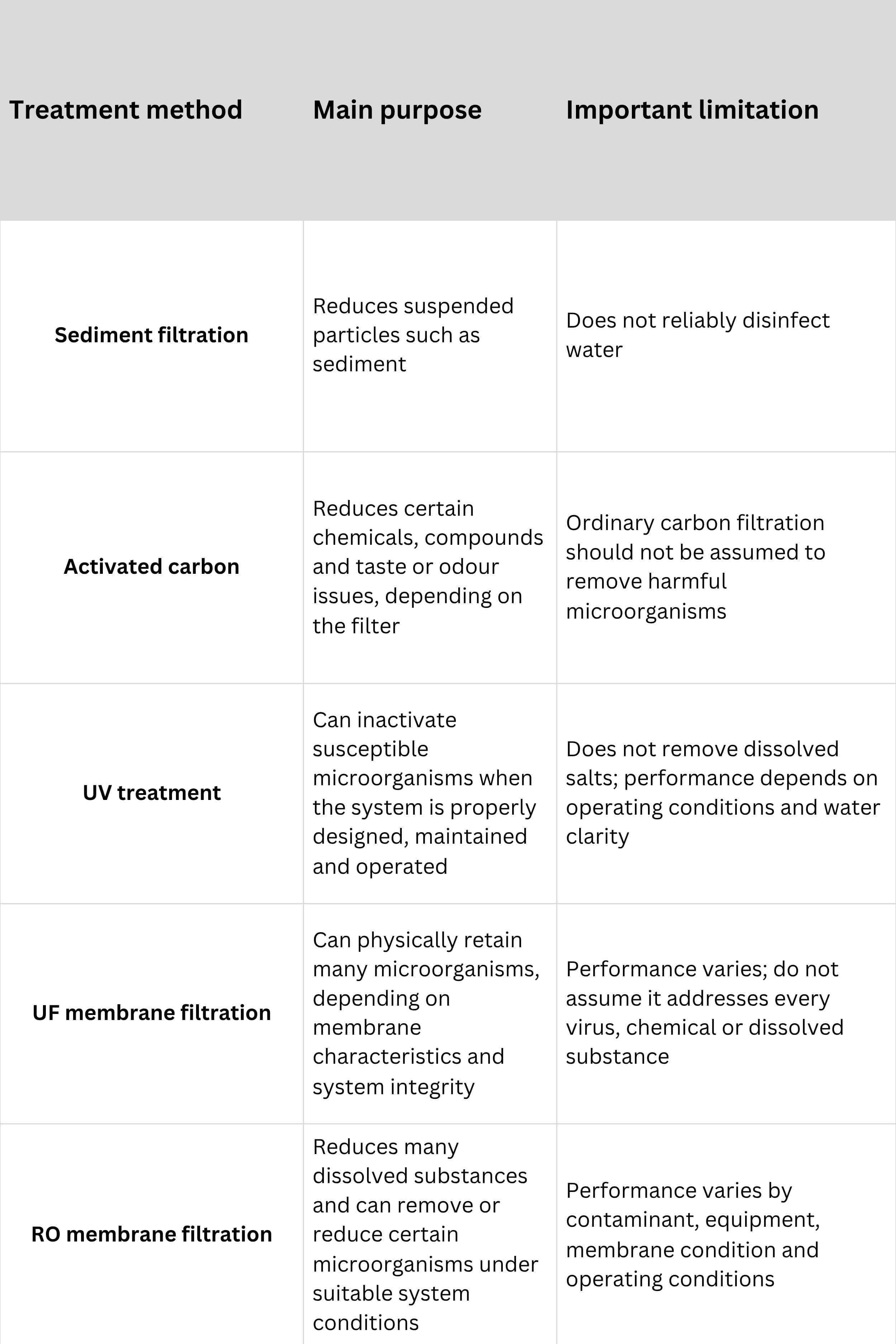
A multi-stage purifier may combine several technologies. The number of stages alone does not establish how effectively it treats a particular contaminant. For example, a household concerned primarily about microbial contamination should not automatically choose an RO purifier just because it has more stages. A properly selected and maintained disinfection or filtration system may be more appropriate, depending on the water source and test results. Likewise, a UV unit is not a universal solution for every chemical or dissolved contaminant. Choose the treatment method based on water quality, not just the product label. The CDC's guidance on home water filters similarly recommends understanding the contaminants present and selecting a treatment system designed to address them
8. Is boiling water enough to kill bacteria?
Boiling is an established way to reduce microbiological risks when carried out correctly. If a credible public-health advisory identifies a microbial risk, follow the instructions provided by the relevant authority. Where an advisory recommends boiling, the CDCadvises bringing water to a rolling boil for one minute; local guidance may specify different instructions for particular circumstances. However, boiling has limitations:
- It does not remove dissolved salts.
- It does not remove many chemical contaminants.
- As water evaporates, some non-volatile contaminants may become more concentrated.
- Water can become contaminated again if it is transferred into dirty containers or handled unsafely.
If water may contain chemical contamination, boiling alone may not make it safe. Follow the relevant authority's advice and use an appropriate alternative source if necessary. For routine household use, do not assume that every municipal supply needs boiling or additional purification. First understand the source, the water-quality information available and any current advisory.
9. Five practical habits for safer drinking water at home
You do not need to panic about every glass of tap water. Instead, focus on sensible preventive steps.
- 1. Understand your water source
- Ask your apartment association or landlord about the source of the supply and the maintenance arrangements for shared tanks.
- 2. Keep drinking-water containers clean
- Wash storage vessels and dispensers appropriately, keep them covered and avoid dipping unclean cups or hands into stored water.
- 3. Maintain household tanks and plumbing
- Arrange suitable inspections and cleaning. Investigate leaks, damaged pipes, pressure changes and suspected cross-connections.
- 4. Test when there is a reason to be concerned
- Seek suitable testing after suspected contamination, relevant advisories or significant changes in the source or plumbing.
- 5. Maintain your water-treatment equipment
- Follow the manufacturer's instructions for cleaning, servicing, filter replacement and UV-lamp replacement where applicable.
These steps help reduce avoidable risks, but they do not replace appropriate testing or a specific public-health advisory.
10. Do you need a water purifier for municipal water?
Not necessarily. Municipal water may already receive treatment intended to make it suitable for drinking. Whether additional household treatment is necessary depends on the quality of the supplied water, the condition of the distribution system, the household's plumbing and storage arrangements, and any relevant contaminants identified through testing. Consider the following questions before selecting a system: - Is the water source known and appropriately monitored? - Are there any water-quality test results or current advisories? - Is the concern microbial, chemical, related to dissolved solids, or a combination? - Which treatment technology addresses the specific concern? - What maintenance does the chosen equipment require? - Are the installation, operating and servicing arrangements suitable for the household? For renters, portability, installation arrangements and servicing responsibilities may also influence the choice. Renting a purifier can be worth considering if you prefer not to purchase equipment upfront or need flexibility when moving homes. However, rental costs, maintenance inclusions, deposits, contract duration and service availability should be checked before making a decision. A rental plan is not automatically safer than an owned purifier. The suitability and performance of the actual treatment system matter more than whether you rent or own it.
1. Can clear municipal water contain harmful bacteria?
Yes. Some bacteria and other microorganisms are invisible to the naked eye and may not change the water's colour, taste or smell. However, clear water is not necessarily contaminated either. Appropriate microbiological testing is the way to investigate whether specified organisms or indicators are present.
2. Is municipal tap water always safe to drink?
Municipal treatment and monitoring are intended to provide safe drinking water, but safety can depend on the supply, distribution pipes, household plumbing and storage. Follow local advisories and seek appropriate testing if there is a credible concern about contamination.
3. Can I detect bacteria using a TDS meter?
No. A standard TDS meter estimates dissolved-solids concentration; it does not detect bacteria, viruses or parasites. A low TDS result cannot establish microbiological safety. Use suitable microbiological testing to investigate potential contamination.
4. What water test checks for bacteria?
A water-testing laboratory can advise on tests for E. coli, total coliform bacteria and other relevant microbiological parameters. The right test depends on the water source and the concern being investigated. Correct sampling and interpretation are important for meaningful results.
5. Does boiling remove all contaminants from drinking water?
No. Correct boiling can reduce microbiological risks, but it does not remove dissolved salts or many chemical contaminants. Evaporation may concentrate some non-volatile contaminants. Follow public-health advice for the specific water-quality concern.
6. Does UV purification kill bacteria in water?
A properly designed and maintained UV system can inactivate susceptible microorganisms when operated under suitable conditions. Its effectiveness depends on factors such as water clarity, UV dose and equipment condition. UV does not remove dissolved salts or address every chemical contaminant.
7. Is RO necessary for municipal drinking water?
Not in every case. RO can reduce many dissolved substances, but the need for it depends on the source water and identified risks. Choose a treatment system based on relevant water-quality information rather than assuming that every municipal supply needs RO.
8. How often should household drinking water be tested?
There is no single testing frequency suitable for every household and every source. The schedule depends on the supply, local monitoring, identified risks and applicable guidance. Testing is particularly worth considering after suspected contamination, a change in source or a relevant advisory.
9. Can water become contaminated inside an apartment building?
Yes, contamination can sometimes occur through poorly maintained storage tanks, damaged plumbing or unsafe handling. This is a possibility, not proof that a particular building's supply is contaminated. Appropriate sampling can help investigate concerns.
10. Should I rent or buy a water purifier?
Compare the equipment's suitability, total cost over the period you expect to use it, installation, maintenance, filter replacements, contract conditions and service availability. Renting can offer flexibility, while buying may suit households that prefer long-term ownership. Neither option guarantees safer water without appropriate treatment and maintenance.
Clear water is reassuring, but testing provides better evidence
Clear, odourless municipal water is not automatically unsafe. Equally, its appearance cannot confirm that it is free from harmful microorganisms. The sensible approach is to understand your water source, maintain household plumbing and storage, investigate credible concerns through suitable testing and select a treatment system that addresses the risks identified. If you live in Coimbatore or elsewhere in Tamil Nadu, your household's actual water source and storage arrangements are more useful starting points than assumptions about an entire locality. And if a purifier is appropriate for your needs, remember that choosing the right technology and maintaining it correctly are essential parts of the decision.link text
RentOMate — Own Less. Live Smart.
If renting fits your household needs, explore the link textwater-purifier rental options available through RentOMate. Check current service availability, equipment specifications, maintenance inclusions and rental terms before making a decision. The first step towards better drinking-water decisions is not buying a particular purifier. It is understanding your water.
Try Rent O' Mate free for 7 days
Starts from ₹449/month – Get pure RO water at home, with free installation and zero maintenance worries.
by Rent O' Mate Team