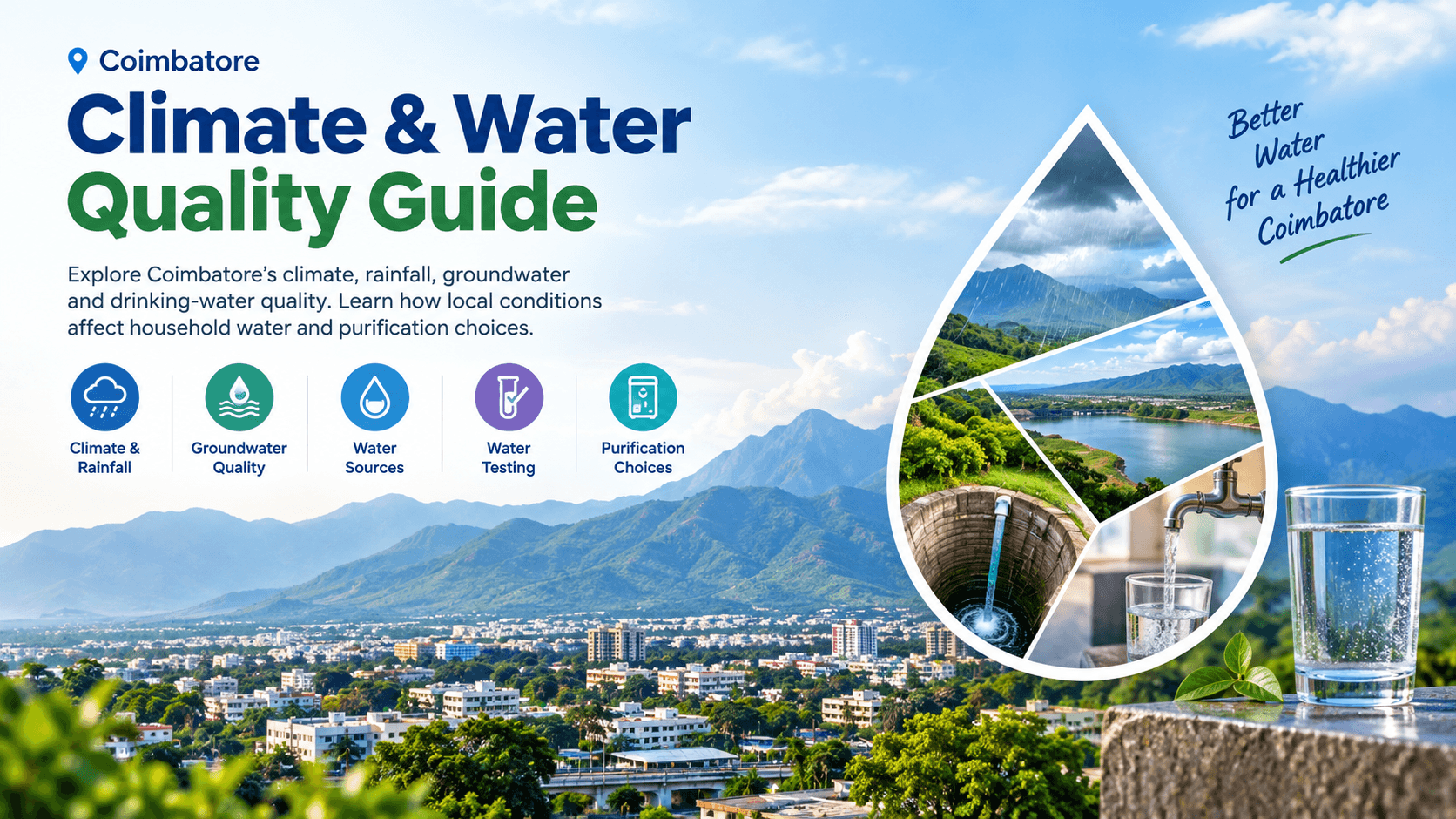
Coimbatore, affectionately known as Kovai, has a distinctive relationship with water. Situated in western Tamil Nadu near the Western Ghats, the city experiences a combination of regional wind patterns, seasonal monsoons, warm weather, and changing water demands. Its geographical setting influences rainfall distribution and the wider hydrological system. The Noyyal River basin, local water-storage tanks, groundwater resources, and water-supply infrastructure all form part of the region’s water story. But what does this mean for the water flowing into your home? A family in Saravanampatti, an IT professional renting an apartment in Peelamedu, and a homeowner in Thudiyalur may depend on different combinations of municipal supply, borewell water, tanker deliveries, or stored water. Consequently, their water-quality concerns may also differ. Understanding Coimbatore’s climate and water signature is not simply about knowing when it rains. It is about understanding where household water comes from, how its quality is assessed, and what treatment—if any—is appropriate.
1. What Makes Coimbatore’s Climate Unique?
Coimbatore’s geographical setting distinguishes it from many other parts of Tamil Nadu. The Western Ghats form important boundaries of the wider district, while the Palakkad Gap provides a major passage through the mountain range. The region includes elevated terrain, undulating plains, river basins, and comparatively dry eastern areas. These features influence local weather and water movement. The Coimbatore District Administration describes the district as lying in the rain-shadow region of the Western Ghats. The Central Ground Water Board also identifies both southwest and northeast monsoons as important sources of rainfall. Sources: Coimbatore District Administration; Central Ground Water Board district assessment. The influence of the Palakkad Gap The Palakkad Gap is a major geographical feature that influences regional airflow and connects parts of Kerala and Tamil Nadu. For Coimbatore residents, this geographical setting contributes to the city’s characteristic weather patterns. However, the influence of the gap does not eliminate hot periods, variable rainfall, or pressure on water resources. Seasonal rainfall patterns Coimbatore receives rainfall from both the southwest and northeast monsoons. Their contributions vary with location, weather conditions, and the period being measured. Historical district-level assessments show considerable variation in normal annual rainfall between different stations. The eastern part of the district, including the Sulur area, has historically received less rainfall than some areas towards the Anamalai hills. This variation matters because rainfall in one part of the district does not necessarily translate into the same water availability everywhere. Warm and relatively dry periods April to June is generally a hot period in the district. During dry spells, household demand, groundwater use, and reliance on alternative supplies may become more important. Nevertheless, the actual availability of water in any particular neighborhood depends on local storage, supply arrangements, groundwater conditions, and infrastructure—not temperature alone.
2. Understanding Coimbatore’s Rainfall: Why the Numbers Matter
Rainfall figures are useful, but only when their geographic coverage and reporting periods are understood. For example, the Central Ground Water Board’s historical district assessment reports normal annual rainfall ranging approximately from 550 mm to 900 mm across six stations, based on data for 1901–2000. The India Meteorological Department’s city climatological table for 1981–2010 reports annual rainfall of approximately 599.5 mm for Coimbatore city. Meanwhile, Tamil Nadu’s district climate dashboard reports 1,510 mm for Coimbatore district in 2023–24. These numbers are not necessarily contradictory. They refer to different datasets, geographic coverage, and time periods. A single year can also be substantially wetter or drier than a long-term average. The important lesson: Never use a district-wide figure, a historical normal, and a single-year rainfall total as if they measure the same thing. For households, rainfall matters because it can influence surface-water availability, groundwater recharge, and the condition of vulnerable water sources. The size of the effect depends on where the rain falls, how much water infiltrates into the ground, how reservoirs and tanks are managed, and how water is withdrawn and distributed.
3. The Seasonal Water Cycle: From Summer to Monsoon
Coimbatore’s water conditions can change over the year. The following seasonal descriptions are general patterns, not guarantees of what will happen in a particular year. Summer: March to June Hot weather can increase household water consumption. If rainfall has been poor or supplies are interrupted, some households may rely more heavily on borewells, tanker deliveries, or stored water. Groundwater levels may decline during periods of limited recharge and continued extraction. The extent of any decline varies between locations and aquifers. What households can do:
- Check whether the source supplying the property has changed.
- Keep storage tanks covered and hygienically maintained.
- Arrange suitable testing if the source is unfamiliar or its quality is uncertain.
- Avoid choosing a purifier solely because it is summer.
Southwest monsoon: June to September The southwest monsoon influences rainfall across parts of the district, although the amount received varies geographically. Rain can support replenishment of water resources, but the effect depends on rainfall distribution, ground conditions, runoff, storage, and groundwater extraction. Where surface water or vulnerable sources are affected by runoff, heavy rainfall can also increase turbidity or contamination risks. What households can do: Watch for changes in the water supplied, follow official advisories, and investigate any unusual change in appearance or quality. Northeast monsoon: October to December The northeast monsoon is an important contributor to rainfall in the wider region. Depending on the year, rainfall can support water storage and groundwater recharge. Intense rainfall may also produce runoff, local flooding, or contamination risks where drainage, sanitation, or water infrastructure is vulnerable. What households can do: Check local water-safety advisories after flooding or major supply disruptions. Do not assume that rain automatically makes water unsafe—or that clear water is necessarily safe. Cooler months: December to February Temperatures are generally more comfortable than during the hottest part of the year. However, cooler weather does not automatically improve water quality. The water source, dissolved minerals, microbiological condition, plumbing, and storage hygiene remain important. What households can do: Continue routine tank inspection and purifier maintenance instead of relying on seasonal assumptions. link text
4. Coimbatore’s Water Signature: Sources, Storage and Supply
Climate is only one part of the water story. The source of water and the infrastructure through which it travels are equally important. Municipal and reservoir-fed supplies Coimbatore’s public water-supply arrangements include sources such as Siruvani and Pilloor. The supply received by an individual property depends on the relevant scheme and local distribution arrangements. Water quality can be influenced by source conditions, treatment, distribution, and household storage. A properly managed municipal supply is not the same as an untreated borewell or tanker supply, and each should be assessed according to its own circumstances. Residents should check the applicable water-supply information with the relevant authority or apartment management rather than assuming that all neighbourhoods receive water from the same source. Borewell and groundwater supplies Groundwater is an important resource in the wider Coimbatore region. Its quality depends on local geology, recharge, land use, groundwater movement, and other site-specific conditions. Some groundwater may contain dissolved minerals that contribute to hardness or affect taste. Other chemical constituents may also require investigation, depending on the source and local conditions. A published study examining nitrate contamination in groundwater in the Coimbatore–Tiruppur region identified concerns in some sampled locations. This is a reason to test relevant groundwater sources—not evidence that every borewell in Coimbatore is contaminated. Research source: Nitrate contamination study. Tanker and privately stored water During interruptions or shortages, households may depend on tanker deliveries or stored supplies. The quality of this water can depend on the original source, transportation, delivery equipment, storage conditions, and handling practices. Where possible, ask for relevant water-quality test results. If the source changes or contamination is suspected, arrange suitable testing rather than relying on taste, appearance, or a single TDS reading. Why source identification matters Consider two homes in the same apartment complex. One may receive treated municipal water, while another property in the area may rely on a borewell or a mixed supply. Even if the homes are geographically close, their water-quality needs may differ. Before selecting a purification system, establish the source and assess the water.
5. Does Coimbatore’s Climate Affect Drinking-Water Quality?
Climate and seasonal conditions can influence water quality, but the effect is not identical across all sources.
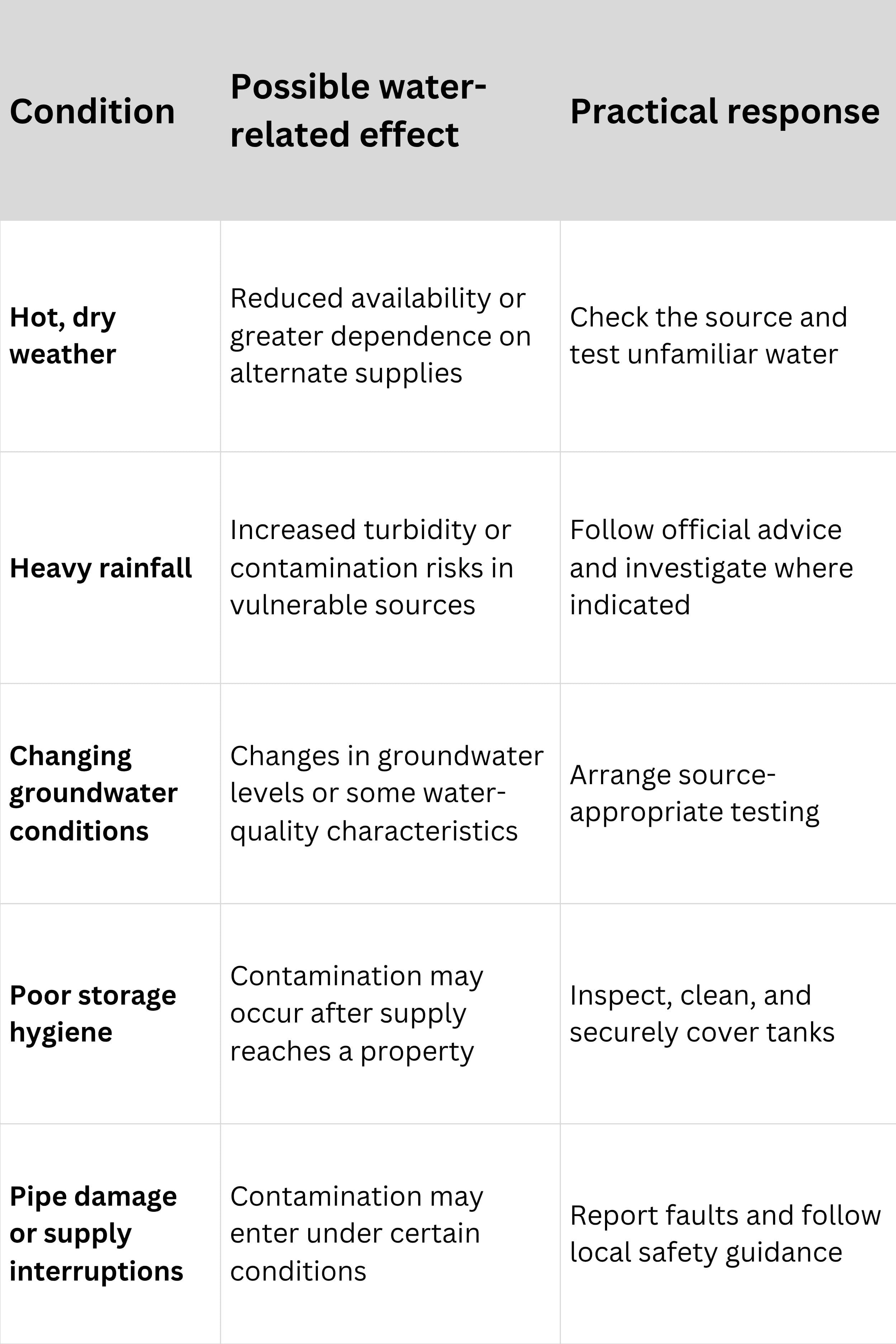
These are possible effects, not a diagnosis of any particular household’s water. For example, a rise in turbidity after heavy rain does not identify the contaminant responsible. Likewise, a change in TDS does not tell you whether the cause is a specific chemical, a change in the water source, or another factor. Testing is needed to understand the actual condition.
6. Clear Water Is Not Always Safe Water
One of the most important lessons for households is that appearance alone cannot establish drinking-water safety. Water may look clear and still contain microorganisms or dissolved chemical substances. Conversely, cloudiness or an unusual taste does not identify a specific contaminant. Microbiological contamination Bacteria, viruses, and other disease-causing microorganisms may enter water through contaminated sources, damaged distribution systems, or unhygienic storage. Sediment and activated-carbon filters do not reliably disinfect water on their own. Properly performed boiling can control many disease-causing microorganisms, but it does not remove dissolved salts, nitrate, fluoride, or most other chemical contaminants. Total dissolved solids (TDS) TDS is an aggregate measure of dissolved substances in water. A TDS meter is useful for screening and monitoring certain changes, but it does not identify every substance present or establish whether water is microbiologically safe. Low TDS does not guarantee safe water, and high TDS alone does not identify the problem. Hardness and mineral content Calcium and magnesium contribute to water hardness. Hard water can leave scale on taps, kettles, and heating elements. Visible scale can indicate a hardness problem, but it does not by itself prove that water is unsafe to drink. Chemical contaminants Depending on the source and local conditions, testing may need to include parameters such as nitrate, fluoride, iron, or other relevant substances. The correct test panel should be selected according to the water source, local risks, and applicable drinking-water standards.
7. How Should You Choose a Water Purifier for Your Coimbatore Home?
There is no single purification method that is automatically best for every home in Coimbatore. The right approach is to identify the water source, obtain appropriate test results, compare those results with relevant standards, and select treatment suited to the identified concern. If microbiological contamination is the concern Use an appropriate, verified treatment or disinfection method. A properly designed and maintained UV system can inactivate susceptible microorganisms, but it does not remove dissolved salts. If dissolved salts or particular chemical contaminants are the concern A suitably selected reverse osmosis (RO) system or another contaminant-specific treatment may be appropriate, depending on the test results. RO systems vary in performance. Do not assume that every system removes every contaminant equally well. If hardness is the main concern A suitable water-softening system may help address hardness and scale. Softening is not the same as disinfection and should not automatically be considered a complete drinking-water purification solution. If the water already meets applicable standards Additional treatment may not be necessary. If a treatment device is used, it should have a clear purpose and be maintained according to the manufacturer’s instructions. A practical checklist before buying or renting
- Identify the source: municipal, borewell, tanker, or mixed supply.
- Obtain appropriate water-quality test results, especially if the source is uncertain.
- Review the results against applicable drinking-water standards.
- Choose a treatment method that addresses the identified contaminants.
- Check maintenance requirements and replacement intervals.
- Consider water recovery and reject-water generation where relevant.
- Retest when the source changes or a significant water-quality concern arises.
Do not assume every Coimbatore home needs RO. The decision should be based on evidence, not location alone.
8. The Hidden Role of Apartment Tanks and Plumbing
Even when the original water supply has been treated, contamination can occur after water enters a building. This is relevant to apartments, gated communities, independent houses, and rental properties where water passes through underground sumps, overhead tanks, pumps, and internal plumbing. Potential issues include:
- Poorly maintained or uncovered storage tanks.
- Damaged plumbing or leaking pipes.
- Unhygienic storage and handling.
- Changes in water source without suitable testing.
- Purification equipment that has not received required maintenance.
A sensible household routine includes inspecting storage tanks, keeping them covered, cleaning them appropriately, and addressing plumbing faults promptly. For tenants, ask the landlord or apartment association when the tanks were last cleaned and whether water-quality testing has been carried out. Cleaning a tank is useful maintenance, but it does not prove that the source water is safe or replace testing where contamination is suspected.
9. A Practical Water-Safety Routine for Coimbatore Households
You do not need to become a water-quality expert to make informed household decisions.
- When moving into a new home: Identify the water source and ask about storage-tank maintenance.
- During summer supply interruptions: Check whether the property has switched to borewell or tanker water.
- After heavy rainfall or flooding: Follow official advisories and investigate any suspected contamination.
- When taste, smell, or appearance changes: Do not guess the cause; seek advice and arrange appropriate testing.
- During purifier maintenance: Follow the manufacturer’s service schedule for filters, membranes, and disinfection components as applicable.
- When test results identify a concern: Select a suitable treatment and verify that it is operating as intended.
If authorities issue a boil-water or other drinking-water advisory, follow their instructions. Boiling is not a universal solution for chemical contamination.
10. What This Means for Renters and Young Professionals in Coimbatore
Coimbatore attracts students, working professionals, families, and people relocating for employment. For residents in rented apartments, water management can be complicated because they may not control the building’s plumbing, borewell, overhead tank, or municipal connection. A tenant may also prefer not to purchase a permanent appliance when planning to move. A practical approach is to understand the supply first, discuss shared infrastructure with the property owner, and select an appropriate treatment solution. Water-purifier rental can be convenient for households that want to avoid an upfront equipment purchase. However, rental convenience does not establish water safety. The equipment must suit the water quality, be installed correctly, and receive the maintenance it requires. RentOMate is relevant to households exploring water-purifier rental options. Before choosing a plan, confirm the equipment’s suitability, what maintenance and replacement components are included, and the applicable rental terms. The objective is not to buy more equipment than necessary. It is to understand your water and choose a sensible solution.
11. Coimbatore’s Water Future: Better Awareness, Better Decisions
Coimbatore’s water-management challenges cannot be explained by rainfall alone. Seasonal weather, groundwater use, surface-water storage, urban development, drainage, and infrastructure all influence how water is available and managed. The district’s geography also creates different conditions across its hills, plains, and urban areas. This makes it especially important to avoid generalising the water quality of one location to the entire district. Households can contribute by reducing unnecessary water wastage, maintaining safe storage, reporting leaks, and making informed decisions about purification. Apartment associations and landlords can help by maintaining shared infrastructure and arranging appropriate water-quality testing. For individual residents, one of the most valuable steps is simple: stop guessing about water quality and start with reliable information. link text
1. What makes Coimbatore’s climate different from other cities in Tamil Nadu?
Coimbatore lies near the Western Ghats and the Palakkad Gap. Its weather is influenced by these geographical features and by both the southwest and northeast monsoons. Rainfall varies across the district and between years.
2. How does Coimbatore’s climate affect water quality?
Seasonal conditions can influence water availability and may affect turbidity or contamination risks in vulnerable sources. However, the effect depends on the source, local infrastructure, groundwater conditions, and storage. Testing is needed to establish actual water quality.
3. Is Coimbatore borewell water safe to drink?
It cannot be determined from location alone. Borewell water should be assessed using appropriate chemical and microbiological tests, selected according to local risks and applicable standards.
4. Does Coimbatore have hard water?
Some sources may contain enough calcium and magnesium to cause hardness and scale. Conditions vary by source and location, so a suitable water-hardness test is needed.
5. Is municipal water in Coimbatore safe to drink directly?
Safety depends on the supply scheme, treatment, distribution, storage, and current conditions. Follow official advisories and seek appropriate testing when there is uncertainty or a suspected problem.
6. Does monsoon rainfall make drinking water unsafe?
Not automatically. Heavy rain may increase turbidity or contamination risks in vulnerable sources and damaged systems. The actual effect depends on local conditions and should be assessed using reliable information and testing where necessary.
7. Is RO purification necessary for every Coimbatore home?
No. RO is useful for certain dissolved contaminants when the water-quality results justify it. The choice should be based on source-water characteristics and relevant standards, rather than city location alone.
8. Can a TDS meter tell me whether my water is safe?
No. A TDS meter measures an aggregate indicator of dissolved substances. It does not identify every contaminant or establish microbiological safety. Appropriate laboratory testing is needed to investigate specific concerns.
9. How often should apartment water tanks be cleaned?
Cleaning and inspection should follow a suitable maintenance schedule based on the tank, supply conditions, applicable guidance, and observed condition. Keep tanks covered and protected from contamination. Cleaning does not replace testing where water safety is in doubt.
10. Where can I get drinking water tested in Coimbatore?
Look for a competent laboratory with appropriate drinking-water testing capabilities. Verify its relevant accreditation and test scope, and ask for a panel suitable for your water source and concerns rather than relying on a TDS reading alone.
Understand Your Water Before Choosing Your Solution
Coimbatore’s water signature reflects its geographical setting, seasonal rainfall, groundwater conditions, surface-water resources, and urban infrastructure. Two households in the same city can have different water-quality concerns because their sources, storage arrangements, and plumbing differ. Whether you own a home or rent an apartment in Saravanampatti, Peelamedu, Thudiyalur, or another part of Coimbatore, the best approach begins with three steps: Identify your water source. Assess its quality. Choose the right treatment. If you are considering a water-purifier rental, explore the options available through RentOMate. Confirm that the equipment and maintenance arrangements suit your household’s requirements before choosing a plan.
RentOMate — Own Less. Live Smart. Understand Your Water.
Try Rent O' Mate free for 7 days
Starts from ₹449/month – Get pure RO water at home, with free installation and zero maintenance worries.
by Rent O' Mate Team