In thousands of apartments and independent homes across India, replacing an empty 20-litre water jar is treated as a routine household task. Yet each full jar weighs approximately 20 kilograms, plus the weight of the plastic container itself. Understanding how lifting 20L water cans affects your spine is essential for families, bachelors, elderly parents, and working professionals who regularly carry jars from doorsteps, lift them over thresholds, or invert them onto tall dispensers.
- A full 20-litre water jar weighs around 20 kg, making it heavier than standard airline cabin luggage.
- Smooth, cylindrical plastic walls force your arms to reach forward, shifting the centre of gravity away from your spine.
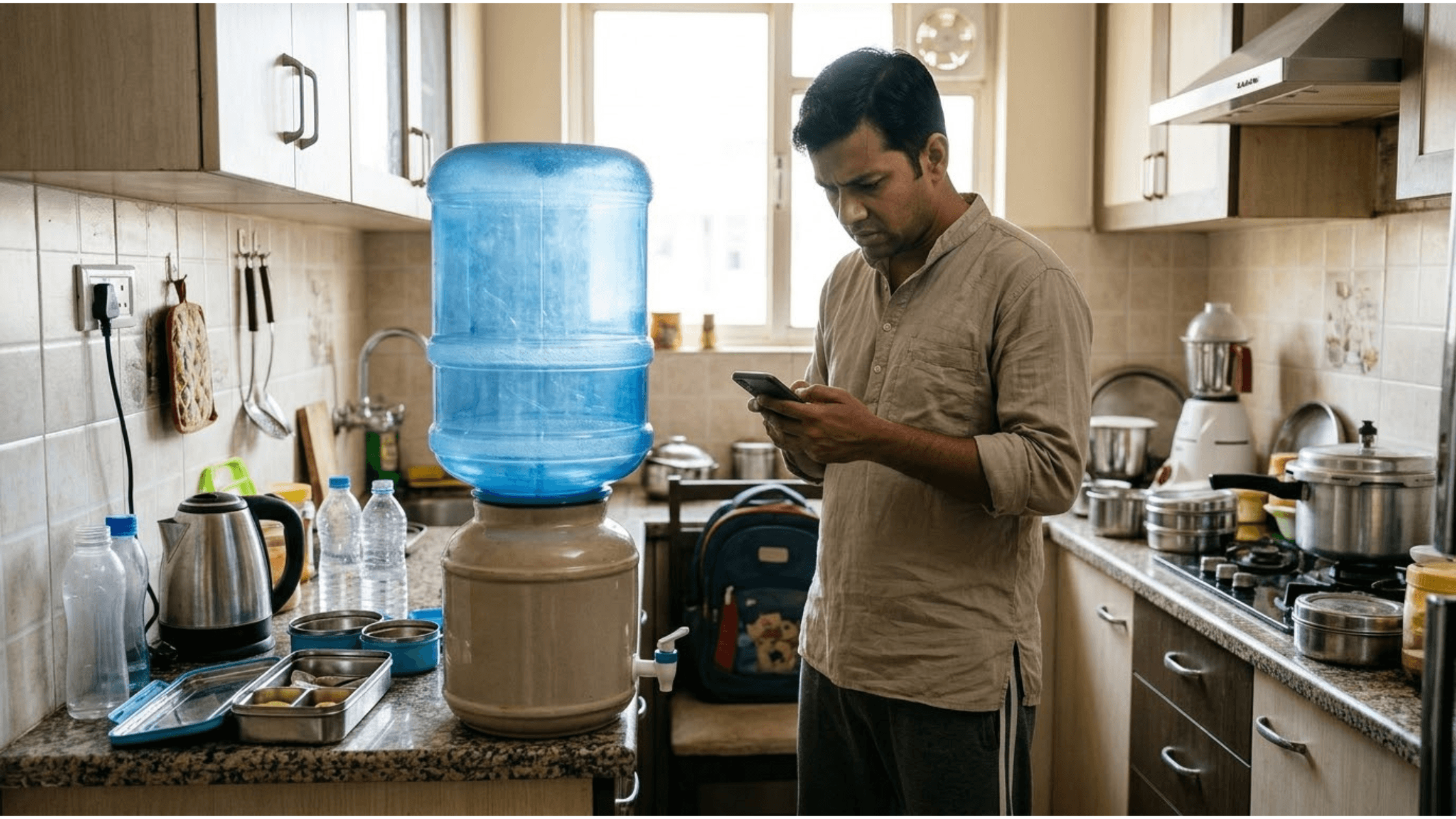
- Inverting a heavy jar onto a top-loading dispenser combines lifting, torso twisting, and overhead arm extension at the same time.
- Replacing heavy water jars with an on-tap home water purifier removes repetitive lifting from your weekly routine.
Why a 20-Litre Water Can Is Uniquely Hard to Lift
Not all 20-kilogram loads affect the body equally. A well-packed suitcase or gym dumbbell has a balanced grip positioned close to your torso. A commercial 20-litre water can, however, is bulky, slick, and awkwardly shaped.
- No built-in ergonomic side grips: Most 20-litre jars only have a narrow neck or a single recessed handle on one side, forcing you to hug the wide cylinder or grip it unevenly.
- Shifting water weight: As you tilt or lift the jar, water sloshes inside, creating sudden momentum that your lower-back stabiliser muscles must quickly counteract.
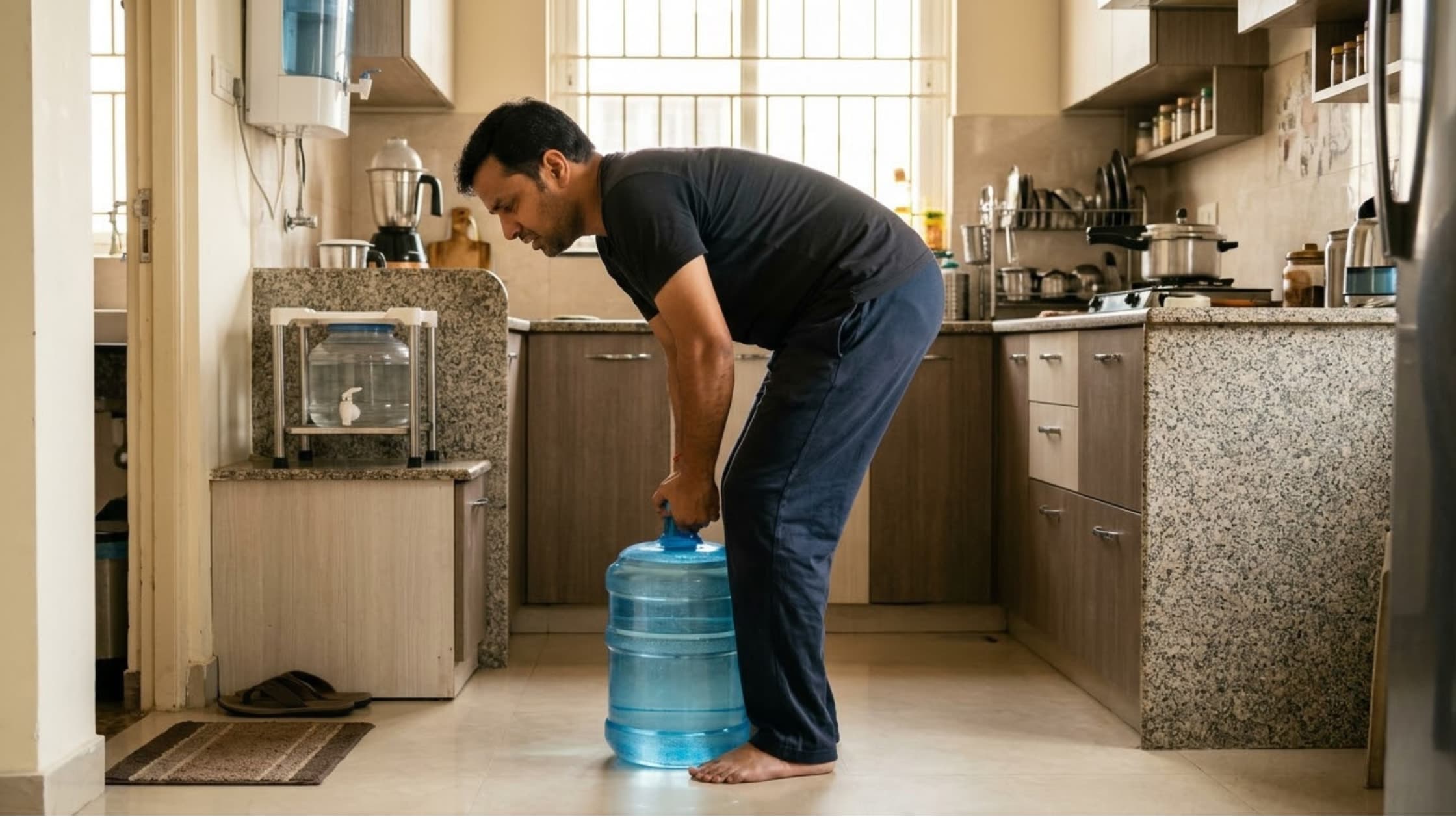
- Low starting height: Delivery personnel usually leave cans directly on the floor outside the main door or in a kitchen corner, requiring a deep bend from ground level.
- High placement targets: Top-loading water dispensers and elevated kitchen counters require lifting the jar from floor height up to chest or shoulder height in a single awkward movement.
How Lifting Heavy Water Jars Affects Your Spine
Your spine is made up of stacked bones called vertebrae separated by soft, shock-absorbing cushions known as intervertebral discs. When you lift a heavy object incorrectly, mechanical stress concentrates on the lumbar region, which is the lower part of your back.
- Spinal disc compression: Bending forward at the waist while holding a 20-kilogram jar multiplies the compressive force on your lower spinal discs, pushing fluid pressure toward the back of the disc wall.
- Lumbar muscle and ligament strain: Sudden jerking motions while hoisting a jar onto a dispenser stand can overstretch the muscles and ligaments supporting your spine, leading to stiffness or sharp muscle spasms.
- Rotational torque from twisting: Turning your upper body while holding a heavy jar—such as swinging a can from the floor onto a side counter—creates twisting shear forces that the lower spine is poorly designed to handle.
- Shoulder, neck, and wrist overload: Holding a smooth plastic jar away from your chest transfers strain into the rotator cuff muscles of the shoulder, the upper trapezius muscles of the neck, and the tendons of the wrists.
Everyday Scenarios Where Back Strain Happens at Home
In residential areas across Coimbatore—such as apartments in Peelamedu, Saravanampatti, and Avinashi Road—delivery routines often create predictable lifting hazards inside the home.
- Dragging and lifting jars from the apartment corridor across raised door thresholds into the kitchen.
- Rush-hour morning replacements when someone hurriedly bends over with straight knees to flip a fresh jar onto a dispenser before leaving for work.
- Elderly parents or family members recovering from minor back stiffness attempting to move a spare jar when no one else is home.
- Bachelors and students living in shared flats carrying full cans up narrow staircases when lifts are unavailable or restricted.
Safer Techniques If You Must Lift a 20-Litre Water Can
If your household currently uses 20-litre jars, adjusting your posture and handling habits can reduce the immediate strain on your back.
- Squat with your legs, not your back: Stand close to the jar, place your feet shoulder-width apart, bend your knees and hips, and keep your chest upright as you lift using your thigh and glute muscles.
- Hold the jar close to your body: Pull the can tight against your abdomen rather than holding it out at arm's length, which dramatically reduces leverage strain on your lower spine.
- Pivot your feet instead of twisting your waist: If you need to turn toward a counter or dispenser, move your feet first so your shoulders and hips stay aligned in the same direction.
- Use a trolley or siphon pump instead of inverting: Place heavy cans on a low wheeled trolley to move them across rooms, and use a battery-operated or manual dispenser pump on the floor rather than flipping the 20-kilogram jar upside down.
- Ask for assistance when needed: Do not attempt to lift a full jar alone if you already feel lower-back tightness, fatigue, or sciatica-like discomfort.
Comparing Heavy Water Cans and On-Tap Home Purifiers
While safer lifting techniques help lower the risk of sudden injury, the most reliable way to protect your back from repetitive water-jar strain is to remove the heavy lifting altogether. Comparing daily physical effort across both options shows how much strain a household can avoid.
| Physical Aspect | 20-Litre Water Cans | Home Water Purifier |
|---|---|---|
| Weekly Lifting Load | Lifting 20-kg jars multiple times a week | Zero heavy lifting required |
| Dispenser Flipping | Requires lifting and inverting jars to chest height | Direct flow from a built-in tap |
| Floor Movement | Dragging or carrying jars from front door to kitchen | Fixed wall-mounted or countertop unit |
| Suitability for Seniors | High physical effort and strain risk | Effortless operation for all age groups |
| Storage Handling | Moving full and empty jars in tight kitchen spaces | No floor jars to shift while cleaning |
Eliminating Heavy Lifting with a RentOMate Water Purifier
Many tenants, families, and working professionals continue lifting 20-litre water cans simply because buying a brand-new water purifier requires a large upfront investment and long-term ownership commitment. If you live in a rented apartment or plan to relocate in the future, purchasing an appliance outright may not feel practical.
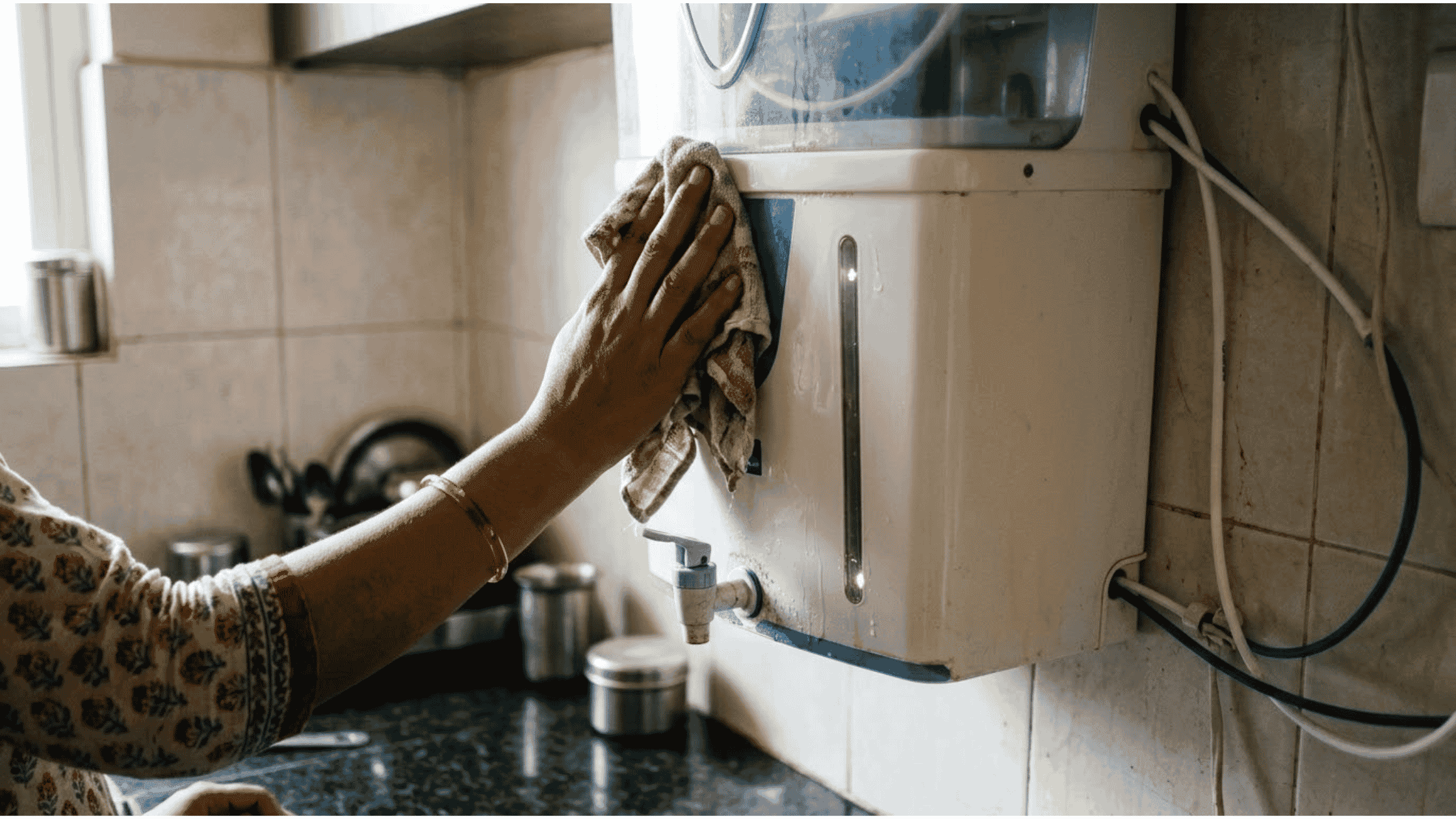
RentOMate bridges this gap by offering a water purifier rental service designed for everyday convenience. Having a dedicated water purifier installed directly in your kitchen means clean drinking water is available at the turn of a tap—eliminating doorstep jar hauling, awkward floor bends, and risky overhead dispenser flips. It is an especially practical choice for households with senior citizens, people managing back discomfort, and busy professionals who want effortless daily hydration.
Because service availability, purifier options, maintenance terms, and rental plans vary depending on your residential address and household requirements, please visit https://rentomate.life to verify current rental terms and confirm address availability in your area.
Protect your back from lifting heavy 20-kilogram water jars every week. Visit https://rentomate.life to explore water purifier rental options and check service availability for your home
Frequently Asked Questions
1. Question: How much does a full 20-litre water can weigh?
Answer: One litre of water weighs approximately 1 kilogram, so a filled 20-litre water can weighs around 20 kilograms plus the weight of the plastic jar itself—roughly 20.5 to 21 kilograms in total.
2. Question: Why does lifting a 20-litre water jar cause lower-back pain so easily?
Answer: A 20-litre jar has smooth, rounded sides without ergonomic handles, forcing you to bend forward and hold the weight away from your body. That posture multiplies compressive pressure on your lower spinal discs and strains lumbar muscles.
3. Question: Is flipping a water can onto a top-loading dispenser bad for the shoulders and spine?
Answer: Yes. Inverting a 20-kilogram jar onto a top-loading dispenser forces you to lift, rotate your torso, and raise your arms overhead simultaneously, which places high stress on your lower back, rotator cuff muscles, and wrists.
4. Question: How can I avoid lifting water cans if I already have 20-litre jars at home?
Answer: Keep the water jar on the floor or on a wheeled stand and attach a top-mounted manual or rechargeable electric water pump. This lets you dispense water into bottles and glasses without lifting or inverting the heavy container.
5. Question: Who benefits most from switching from water cans to a rented home water purifier?
Answer: Households with elderly parents, individuals experiencing back or joint strain, families with high daily water consumption, and tenants or bachelors who want on-tap drinking water without buying an appliance outright benefit the most.
6. Question: Where can I check water purifier rental plans and availability for my address?
Answer: You can review current rental options, terms, and address availability directly on the RentOMate website at https://rentomate.life.
Conclusion
Lifting 20-litre water cans may seem like a minor weekly chore, but repeatedly hauling and flipping a 20-kilogram plastic jar places real, cumulative strain on your spine, shoulders, and wrists. Squatting with your legs, keeping the jar close to your torso, or using a floor pump can make handling jars safer in the short term. If you want to eliminate heavy water-can lifting from your home permanently without buying an expensive appliance, check current rental plans and address availability at https://rentomate.life.
RO water purifier on rent in Coimbatore
From ₹449/month with free installation, service and filter changes. Try it free for 7 days.
by Rent O' Mate Team